
Telling Stories

One of the things they teach in HR school is a special kind of interviewing. (It may not be that special anymore; I think the word has spread.) It’s called STAR, or something akin to that, representing Situation, Task, Action, and Result. In this form of behavioral interviewing, the interviewer is looking for specific examples of what you have done in your past that are likely to reveal what you would do under certain–similar–circumstances. Presumably, the circumstances are a lot like those you might face on the job you want, or think you want.

For example, suppose you want to be a Human Resources professional, and you are interviewing for an employee relations job. Now, employee relations is usually the section of the HR department where they write and administer the handbooks, policy, and problem solving procedure. Employee Relations folks are likely to need patience, the ability to defuse tension, an eye for detail, and tolerance for what others might regard as mind numbing discussions of who did what to whom and why. They care about justice and are generally good at relationships.

If you want such a job, you would also want to be prepared to be asked questions like:

Was there ever a time when you were confronted by an angry person  who demanded your immediate attention on a matter of great detail and who publicly threatened you? (Situation) If so, tell me what you saw that needed to be done and why (Task) and what you did (Action). What was the Result?

The point is that if the interviewer asked, “How do you handle the anger of others?” you would be likely to say something like, “I’m the kind of guy/woman who doesn’t back down.” At which point you and the interviewer would begin a time honored ritual of trying to understand each other. Frankly, no one but you knows what you mean when you say you won’t back down. Is that like Tom Petty won’t back down or like Katie Couric won’t back down? As you can see, it’s not illustrative.

A story is what is required here, a story about a definitive moment in your life or career when your special skills were called upon and you either successfully or unsuccessfully pulled them out and put them to use. Good storytelling skills can help you–not in redrafting the stories of your life, but in relating them with adequate brevity, focus, organization, and color. Storytelling for career development is a critical skill and a competitive advantage.

There are other reasons to learn to tell good stories–mentors find that illustrative stories are softer learning tools that are less direct and more personal. Leaders often use inspiring stories to make a point and set a culture. Recruiters tell motivating stories to make you want to go to work for a company or executive. You need to tell a good story to show who you are and why you should go to the next step for the job you want.

There are lots of good books about storytelling, written by storytelling professionals; you should get to know something about the topic in general. But here is my advice about responding to STAR interview questions with an effective story.

1. Do your homework. What do you think the job requires? Do you have it? When did you last use it? What did that look like?

2. You are the hero of this story, whether you are comfortable with that or not. This is not a time to downplay your role. You are describing yourself–by telling both what you did, and revealing what you did not do. Remember this: one of the more effective aspects of behavioral interviewing is that it allows the interviewer to observe what you did not do–you can’t hide what is not there.

3. Be brief. The color of your shoes and the name of the street you were on probably are not relevant, so you can leave them out.

4. Focus on what you want to communicate–your behavior and how it affected/effected the outcome you wanted, or, if you are a huge risk taker, how it caused exactly what you didn’t want and what you learned from that. Tempting. I wouldn’t, but we’re all different.

5. Stay organized; provide details in order. Don’t throw in a flashback or surprise ending or you will spend the next ten precious minutes regrouping.

6. Keep the drama to a minimum–do not make faces, add tone to your voice, or wave your hands around. All of these diminsh the quality of your words.

7. The story should be self explanatory. You should not have to go back and explain how this anecdote relates to the question you were asked. If you have to, know you missed the mark, but your best bet is to provide only two more sentences: “Well, here’s what I learned from this experience: (add learning here).”

You can practice this. You can learn to think in stories and STARS. Since the best interviews turn out to be conversations, your goal is to tell a story that lifts up your conversation, lengthens it, and gets you asked back for another, and another.  Good storytellers are warm and a little fearless when they reveal details about themselves.  Don’t apologize, defend yourself, or alter the details after you’ve provided them.  A credible story is always better than a careful one–you are human, after all, and it is your story.

The Best Tools in the Kit

 Because many of us don’t consciously manage a career,  most of us don’t think we have a set of tools at hand.  When you think of career management skills, you probably think of skills we pull out,  polish up, and put to work  when the time comes to tinker with the job market–like interviewing, resume writing, or networking skills.  Job hunting’s most important tools?   Resource management skills.  You use them every day, or you can.

What are your resources?  How do you manage them?  Resources, for this purpose, include time, people and organizations,  information,  money,  and the physical environment.  Everything you do in pursuit of your employment objective is going to involve managing one or several of those things.  The better you manage them, the better the outcome.

What do we mean, manage resources?  It means that you first recognize that you have a finite supply of everything, including things like your friends’ goodwill, so you have to make sure that you budget, that you leverage and deploy  whatever you have appropriately and effectively, and that you monitor your resource balance to make sure 1.) you are treating all of your resources with respect,  2.) you are not about to suddenly run out of what you need, just when you need it, and 3.) that you are replenishing your supply. 

What does resource management look like? 

Time management is a pretty time honored concept.  Most folks think of it in terms of days, weeks, months, as in your weekly planner, daily to-do list, monthly or quarterly goals.  But what about time management in the sense of your youth, your high earning years, or your middle age?  In a job and career sense you have only so many temporal hiding places, only so many chances to work abroad, stay put until the kids finish high school, or sit tight until the right opening presents itself. 

Information management is not just information technology.  Managing information includes how much you share about yourself, how much you keep to yourself for lots of good reasons.  Information is what you need before you start networking, not what you get when you network, thoughyou may stumble over useful tidbits from time to time.  How you gather and use information, how you organize and communicate what you know, how you process–that’s all information management.

Physical environment: your nonliving and nonvirtual resources–your phone, your computer, your home, your car, and the like.  Usually, it’s the physical environment that trips you up when you least expect it.  Don’t believe me?  When was the last time you backed up your contacts file?  Ran your antivirus software?  Dumped your garbage files?  Or–have you investigated that leaky tire on the car, dry cleaned the interview outfit, or shined your shoes?  How about your paper files?  Business cards?  Workspace? all organized?

Money management It’s a biggie, no doubt about it.  Include in the management of your funds items like your frequent flyer miles, your housing costs, your financial decisions.  If, for example, you find yourself unable to take advantage of an opportunity in New Jersey becasue you are figuratively underwater in your home in Florida, we’d call that a money management effect on your career.  The point of conserving your resources is so that they will be there to meet your needs, whatever they are and whenever they happen.  You can’t stretch them past the breaking point, or fake them. 

People and organizational resources– relationships.  Oh, are these ever important.  If you have left a trail of dead or broken bodies in your wake, you will soon find how unimportant were some of those points you just had to make, or arguments you had to win.  Career-wise, nothing is more important than people who like you and want you to succeed.  I think of a family, for example,  as an organization.  A family requires management, and doing this well will spare you the grief that comes from doing whatever feels good and expecting it will pay off job-wise.  It won’t. 

Usually, we manage relationships, not people themselves, and if you take good care of your relationships you will find that they are there for you over many years and more than one career.  That means holding up your end of the friendship, being there for people, keeping the relationship alive and well.  

But who is the most important resource in your career?  You are.  And as such, you have an obligation to manage yourself, to stay healthy, learn endlessly, and grow with determination.   Managing yourself is the hardest thing you will do–it does take discipline, it does require self control and it does involve making difficult choices when you’d rather make the simple one and just do what you feel like doing.  The payoff is far away and the results are not easy to see right away.  But self discipline is the tool you can count on all the time–once you have it.

It Doesn’t Work That Way

You see a job posting.  You like the title, like the look of the job, love the location; you know you are perfect for this job.  You push the send button on the resume you use for all the perfect jobs you find, the ones you just know you can do better than anyone else.  All you have to do now is wait for the phone call, the interview, the offer. 

Okay, it really doesn’t work that way.  You have just made a mistake.  Well not a huge one, but I think the odds are not in your favor.  Here are some reasons why:

1.  The job might not exist at all.  Oh yes, it’s posted somewhere, and someone might have held that job once upon a time, but for now it might very well be a budget placeholder, approved and funded and as long as it’s empty, keeping a department somewhere in high enough cotton to protect the really valuable jobs and people in them.

2.  An agency, recruiter, or contractor is gathering resumes and hoping to score paying clients–either you or a company who will soon get your recently floated and slightly redacted (missing your name and contact info) paperwork.

3.  The posting is required by the company’s affirmative action plan or other internal policy, but the real candidates are already working for the company and have been preparing for that job for many years.

4.  The posting is required by the company’s affirmative action plan or other policy, but the real candidates are those who will see the posting and look for a friend or other inside connection.  The friend will hand carry a specially crafted version of the clever candidate’s  resume complete with personal recommendation to the hiring manager or top HR executive with a friendly smile, and hope that he or she will earn the usual bonus for referring the candidate who gets the job offer.

4.  The job has been posted four times this year and hundreds of candidates have been screened.  No one is hired because the job is really a political minefield between two department managers who want control of the turf, budget, output, and incumbent.  Lucky you, this one is the bullet you dodged.

5.  No one wants to tell the sucker to whom the job reports that this is really his or her job, once the reorganization takes place.  Meanwhile half the company is in on the strategy to “just leave it alone, we’ll tell him/her when the right time comes.” Or we’ll get HR to do it, so don’t let them in on the secret.

6.  The job was eliminated a month ago, but those lists are automated and the recruiter who is supposed to correct the list is on vacation/furlough/sick leave/drugs.

7.  The job listing will eventually expire and this will all be resolved.  Nobody ever gets hired from those job boards anyhow.

So, you say, this makes no sense.  Why would my perfectly good resume not make everyone over at that crazy company sit up, take notice, and call me right away, even if any of those things you said are at least slightly true?  Because that’s not how it works. 

Fewer than 4% of all the people who get jobs this year will get them by hitting that send button and applying for a job they saw online.  My deepest suspicion is that in that 4% are those who were directed to apply that way because the company has no other way to connect its applicants with its tracking system, and so they referred the insiders to the outside to get them officially inside, if that makes any sense.  Applicant tracking systems are supposed to do a lot of heavy administrative lifting, but they have rules and standards that must be obeyed.  Some require that you all use the same front door, hence the need to have your buddy lead you to and through it.

My very favorite authority on finding a job, Nick Corcodilis, has the definitive analysis of why you don’t want to pin your hopes–any hopes at all–on job boards:

Job-Board Journalism: Selling out the American job hunter (from 2003 – but still valid as the day is long…)

And that resume of yours.  When you load it up with all the cool and award winning stuff you ever did, making such a heavy handed case that you must be the Right One, and so that it will work for all the jobs you might ever want. . . well, you look a.) old, b.) desperately competitive, c.) not fun to work with, and d.) a little naive. 

Attaching samples of your work.  No, a thousand times no. Once your work is done, it’s over.  Even though I might love to revisit the very first compensation plan I ever wrote from beginning to end, some of the people it covered are gone now, for good.    Yes,  the plan is over for them, as it was over for me when the plan year and my employment with that company ended. 

On the other hand, when your stripped down sports model of a resume is hand carried by either the retained search firm who got your name from a good buddy of yours that you had lunch with last week, or your good buddy himself or herself, it doesn’t matter what’s on the resume. 

What gets you the job you want is a relationship with someone who can get you invited into a great conversation with the decisionmaker, who ends up liking you, trusting you and wanting to work with you.  Period.  That’s just how it works.

Plan for Success

Many years ago, I was in a mid level human resources management job in my hometown, in a wonderful, diversified company that provided me with enormous job satisfaction, extraordinary compensation, terrific benefits, and great experience.  I liked the job, loved the boss, and learned a lot.  And I knew it couldn’t last forever, maybe even not much longer.  The year we paid no bonuses, I made a plan.  The three things in my plan were:

 In order to qualify for another senior level human resources job as good as this one, I must complete my undergraduate education and obtain a master’s degree.  (I had five years of college but had left school before graduating.)

 In order to have the greatest number of choices of jobs in my profession, I must become an experienced and confident traveler.  (I had developed a fear of flying, and had not had to travel much over the prior ten years.)

 In order to build a good future in my profession, I must get a good job in a Fortune 500 company and build a more substantial list of professional accomplishments.

It took me five full years to do these things, but I can’t tell you that I would have done them had I not a serious conversation with myself.  To be honest, there were five things; I also had to dump a loser boyfriend and get comfortable with the idea of relocating to small Midwestern city far from my native Pittsburgh.  If you want to list ten things, that’s your choice, but you have to have three, and you have to write them down and revisit them from time to time.

If you look at my three things, you’ll see a couple of important words that tip you off to what I was determined to have in my career.  These are the things I work for; look for the things you work for when you identify and compose your own success factors.

First, I used the word “senior” level.  I knew I wanted to move up in my profession—I wanted influence and I wanted to be the top HR person wherever I worked.  Throughout my career, I found that I was sufficiently “different” in the way I approached the HR profession to warrant avoiding a reporting relationship with a more traditional HR executive.  I love reporting to business people, and I don’t mind breaking HR traditions when I do; it’s easier to just admit it than to try to defend it when things don’t work out.

Second, I work for choices.  I always want as many choices as I can garner.  In the instant situation, a fear of flying was going to limit me in ways I could no longer deny.  Getting over it was going to have to happen if I was to have the choices I craved in my next job.  Besides, it was a silly fear, it made no sense,  and I could not defend it.

Third, I am future oriented.  I am always looking down the road.  I’m a planner.  I know a future doesn’t just happen; you build it.  I’d spent many years and was about to spend many more in a wonderfully entrepreneurial company with some of the most terrific folks I’d ever meet.  But I wasn’t well-educated, and now my experience was not as competitive as my peers, as well, having taken place in a largely unknown place, no matter how financially productive that had been for me.  If you want to do HR you have to do it in great places with good HR names associated with them.

 When you establish your success levers, you must:

 Be precise; state what you mean.  This isn’t the time to be general, obfuscating, coy, or excessively demanding of yourself.  Getting an MBA is not the same as just going back to school.  You might not need an MBA; you might simply need to master principles and the language of accounting. 

 Be truthful with yourself.  If you have spent the last ten years addicted to a raft of Tivo’d soap operas or you spend your evenings with Nintendo or Wii, and now you are going to have to use that time and your intellectual resources more productively, this is important to acknowledge, and this is one place in the planning process where you must mention it.

 Correlate what you must do with why you must do it.  “In order to build my reputation as a clear-headed, reliable EMT supervisor, I must stop spending my off-hours in Bob’s Bar and begin using the time to volunteer for additional shifts.”  “In order to build a stronger network of caring people who will help me, I must volunteer for some committees at the church.”

That’s all:  Precision, Truth, and Correlation.  But once you have articulated what you have known all along, it isn’t as big, it isn’t as scary, and it isn’t avoidable.   It’s there to be done.

What to Give Your Kids Before Graduation: Respect

A few weeks ago, I went to the grocery store on a weekday morning. I think I’d been listening to the Swine Flu story at great length, and was advised by some authority or another to have groceries on hand in the event of . . . well, it wasn’t clear if the point was an illness in my house or an epidemic so pervasive that we wouldn’t want to shop. Living in hurricane preparedness country, I know the drill, however.

Weekday morning traffic was light in the aisles of my local Publix, the better to overhear the cell phone conversations of my fellow shoppers, as it turned out. You know how we all start in the bakery, go through the deli and the produce, and then finish up in ice cream? In other words, you can’t get away from the people you entered with? In my case, I was doomed to shop alongside a woman who was, shall we say, highly critical of her teen-aged daughter.

I didn’t want to listen. I had no choice. She was angry, she was loud, she was blameful, she was articulate, she was disloyal; she was, I think, either entertaining or soothing herself—at the expense of her child.

I wasn’t alone in the store; we live in a small enough town. The Talker Mom was no doubt recognizable to many people, though I don’t know her (yet). No matter; from the sound of this rant, she will tell her stories time and again to many, many “friends.”

Of course it gets worse. In her shopping cart, attentively listening to the sound of her mother’s voice and words, was a two and a half year old toddler, presumably the errant teen’s younger sister. Who was learning about her world, and not getting her mothers undivided attention and gentle guidance.

Here’s what I think I heard, while trying to organize flu food. The teenager is at or near puberty, may have a mild learning disability, is frustrated and is frustrating to parents and teachers, is given to tantrums and willfulness, misbehaves, talks back, refuses to do chores and homework, skips classes, and is comprehensively unpleasant to have in the family home. And it’s her teachers’ fault. Mom’s diagnosis: bored with school, learns bad habits there, friends are unsuitable, and she got them at school, too. Oh, and may be depressed.

I know you are as appalled as I am. This is wrong on so many levels that it hurts to write about it; it was hard to listen to. But all I can think about is that Talker Mom is systematically destroying her daughter’s prospects for a future. Never mind that she built the adult-to-be with whom she is so angry—blame is not the subject. The cold hard fact is that if your parents can’t recommend you to anyone, no one is going to want to hire you. This angry parent is telling the world to stay away from trouble: her daughter. It’s a sure bet that when Mom’s anger subsides, and the hormones get back in line, and the family vacation turns out okay for a change, Mom will be happier, but the neighbors will remember that this is one babysitter not to call.

Don’t be this parent. I’m not a therapist or a parent of a teenager, but we all know how difficult parenting can be and that mother-daughter relationships have special problems, and blah, blah, blah. As a practical matter, your children learn about work from you. The world learns about your children from you. You are the source. You are essentially writing their resumes. Think about what you really want for your kids in the long run.

And consider what you really want the next time you take your children out of school for a long weekend vacation, when you complain in front of them about your miserable day and your lousy supervisor, when you violate your daughter’s trust and privacy by sharing her intimate problems with your book club, when you have one too many drinks and drive the carpool anyway, when you fail to discipline yourself and encumber the kids as a result. Or when you teach more spontaneity than planning, when you fail to budget time and money, when you talk about friends behind their back, treat others with disdain, and compete for anyone’s attention on any available platform. Your family is the first organization your child experiences. Are you the leader? If so, what are you teaching, explicitly or by example?

Get Your Assets in Order

The Job Whisperer’s top eleven personal assets and must-have resources for almost anyone (but especially young professionals) seeking a 2009 career brand, because passion and determination are no longer enough.

Resume.  Your resume should proclaim “I love work!” and “Bosses love me and give me lots of responsibility!”  Don’t just enjoy talking about work and responsibility, be unable to waste time.  Work when you aren’t working, talk about what you love about your work.  Be your best advocate.  That’s a brand with energy and a brand you want to be.

Research.  What are the available jobs in your community?  Are they clustered in one or another sector, profession, or discipline?  Once you have established where the jobs are, you can build your campaign in the direction of the jobs, sector, profession, or discipline.  This process increases your understanding of the depth and breadth and capacity of your market, making you a better marketer of your brand and its value.

Reputation.  Be the calm level-headed one.  There’s one in every group, at least one, who gets things done and maintains order and forward mobility.  Be that one.  There are other desirable and fun things you can be, of course, but if you want a solid brand image for the ages, this is it. 

Nice, Stable Friends.  If you are a shy person, make new friends anyway.  If you start friendships but have trouble maintaining them, this would be a good time to learn how to manage your time so that you can spend it with others.  Start a walking group, go to your neighborhood association meetings, find a church and reach out.  People with friends have networking opportunities; people with nice, stable friends have good prospects.  People without friends and people with unstable friends have a harder time finding a job or moving a career forward.

Sturdy bridges across relationships.  Don’t burn bridges, and mend any you may have damaged.  Learn the art of restraint, by simply restraining your impulses.  The first question in the mind of a decision-maker or network contact is:  “Is there a downside risk here?”  Make sure that when your name comes up, the first association is anything other than the word “trouble.”

Advisers who want you to succeed.  If you have not been good to others or yourself, that’s a brand you don’t want.  Stop that right now, and make the fact of stopping unproductive behavior your central story as you seek people who are willing to forgive you and help you.  Like the prisoner who found salvation, the addict who found recovery, or the bully who became the defender of the meek, your story and brand will have to be about change.   The point of a brand is to be memorable in a good way. 

Personal Philanthropy.  Volunteer at one thing, not at a million things, but make it a significant volunteer gig that reflects something you really care about.  Try to achieve a leadership level in a small but important organization, make a professional contribution (do the accounting, the brochures, or raise funds), or found a new organization.  Volunteering at the nuts and bolts level (which lies above the pair of hands level) puts you in touch with members of the organization or the organization’s board, in addition to the organization’s constituents.

Publication.  It can be a blog, a Facebook page, a website, a series of articles, or even a book, but publish your thoughts and ideas.  Publishing what you know and what you care about will set you apart in a world of talent.  Publishing doesn’t make you an expert, but it makes you someone with a point of view, someone with confidence, and someone worth talking to.  Use your spell checker and if you need one, enlist an editor from among your advisers. 

Good Stories.  Good stories about your life experiences have a defining quality, and a beginning, a middle, an end, and an outcome.  And a central figure: you.  They are sometimes the kind of stories you might recount on a grad school application, or you might tell in a speech, or to a new but important person in your life.  Our stories are unique, and that’s why we tell them—they present energy, evoke empathy, and create bonds.  Reflect on the important moments and experiences of your life, and build your stories around them.  Be honest, but not exhaustive.  Good stories are brief but powerful.

Sales Training and Experience.  Get yourself a sales job, just for a while, even if—no, especially if—you have no idea how to make a cold call.  Everybody should work in sales sometime during a career.  Working in sales teaches you what drives the top line.  You will learn to sell yourself, deal with complete strangers confidently, and express your value, even if you never want to sell anything again.

Entrepreneurial mindset.  When I was a pre-teen, my grandmother gave me one of those potholder-making kits.  Before long I’d made thirty or so colorful potholders, I’d organized my younger siblings into a door-to-door army, and I was asking my parents for more equipment and raw material.  This is when my father explained to me the concept of profitability and the role played by expenses.  A business owner understands problems from a different angle; be self-employed somewhere along the line.

It’s hard not to notice that Great Big Honking Network is missing from The Job Whisperer’s list.  Well, it’s in there, in a way, and in another way we think that it’s not so much a noun as it is a verb.  It’s something you do in order to meet nice, stable friends, build sturdy bridges, and locate advisors who want you to succeed.  Sometimes the shorthand in articles and books about jobs and careers is confusing, and sometimes we mistake profiles in cyberspace for members of a network we own.  Here’s the difference.

You can have a network, you can build a network, you can promote a network, you can be a member of a formal networking group, but it’s not really an asset or a resource unless or until it includes nice, stable friends, sturdy bridges across relationships and advisors who want you to succeed.  The network is a conceptual framework representing what you make of those assets and resources, at a specific time when you need a very specific kind of help.  It isn’t real.  You don’t wake up one morning and decide to procure one of those network thingies. 

Imagine having a party and inviting all your friends and acquaintances.  When you stand up to toast the guests, are you going to say, “Here’s to my wonderful network!” or “Here’s to my wonderful friends!”  I hope you see the difference. 

I think it’s okay to map your conceptual network to try to find a path to your goal.  I think you must build a data base of your friends and advisors, and identify the sturdiest bridges, and connections you need to work on.  But these are activities best done in the spirit of organization, not exploitation, and there is an important difference.

Why Does it Take So Long to Get a Job?

You were laid off in December, took the holidays off because you think no one is hiring in December anyhow, and started working on your resume in January.  You finished a first draft, passed it around to your friends in the biz, got some feedback, made some changes, and now you think it’s ready to go. You’ve got some networking meetings set up, and you’re checking the job boards for whatever might turn up in your area.  You’re willing to step outside your profession if the right opportunity comes up, and you see yourself as flexible.  So now it’s what, mid-February?  How long is this going to take, exactly?

 Here’s how you see you getting a job:

job4me1

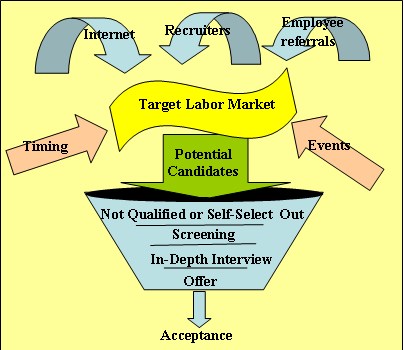
Here’s how the company sees the process:

funnel1

Big difference.  And the bigger the company, the bigger the difference.  For you, this is fairly linear.  For the company, this is a big fat budget item with lots of twists, turns, and performance measures and objectives, and with staff and money (and maybe company politics) involved.  No rush on this, by the way, because conducting the business of the organization takes priority over filling open jobs, and fastest isn’t always the best when it comes to hiring. 

 Note the arching blue arrows in the second diagram—those are the investments that companies make in order to find people who fit.  Although the arrows are all the same size, the investments and their value are not the same.  More weight is given to the best sources—the ones that pay off consistently with a terrific ROI, however the company defines that.  Most experts believe that the best ROI comes from employee referrals, and the lowest selection rate is from the internet, but there are exceptions. 

The pink arrows show the influences that affect the size of the labor market.  Some events cause a labor market to grow; sometimes a market shrinks in response to events.  One example of timing is the college graduation season (causing the labor market to grow in some places and shrink in others), another is tourism in seasonal markets (causing the labor market to shrink).  When labor (also called talent) is plentiful, company investment in outreach slows; when the talent pool shrinks, the outreach spend goes up.   A labor market may be huge but the number of potential candidates suitable for a job may be very small.

 See the green arrow pointing down?  That’s you and your competition—some are just names the company has been keeping an eye on, some are friends of employees, and some are just like you, a five or six week old resume with an unemployed citizen attached to it.  Most won’t get to the next step. 

If they/you do, the blue bucket contains all the hoops left to jump through, and there are probably several hoops at each level.  The higher up in the company the job is, the greater the number of interviews.  However, if you are in the line for a training program, internship, or other visible slot, the more complicated are the hoops.  You might add Assessment Center Testing, Group Interview, or Day of Informational Interviews and Reckoning to that list of hoops.  It can take months—lots of months—to get through the entire process.  And then the job might be eliminated before it’s filled.

 Keep in mind that while all of this is going on, the salary and benefits money for the approved open position is not being spent.  Though work might be piling up, the department line item is favorable to budget, and the chances of the position being cancelled without being filled grow with each passing week.

 Remember that some companies post jobs for their employees across the country to bid on and may assess all or some of their internal candidates before considering external applicants. 

Some companies interview a slate of applicants and focus attention on the job all at once.  Some companies interview when they see someone they like.  HR handles logistics and scheduling, but they don’t control it.  There are references to check and details to verify. The decision-maker decides when it’s time to hire, and no one gets hired until that happens.  Newsflash: you have no control over any of this. 

 When someone tells me they got a call about a great job, or a headhunter called them, or they sent a resume in response to a job posting or ad, I suggest they not get ahead of the company’s plans.  You are not in a committed relationship with the company, its recruiter, a job, or the prospect of a job.  You are just you, same as you were yesterday. 

 So how long does it take to get a job?  A long time, once you find you are actually in the running for one.  Longer, if you find you are not. 

Sometimes it all works out, but it takes time.  When the process begins to drag out, it’s not a good sign for you, although I once got a job offer after another candidate turned it down.  It was a great job; it just took a while to get it.  I had already moved on, and so was clear-headed and thus able to see that my negotiating position had improved.  I believe that I got a better offer by staying calm and by being a smidge less anxious to jump aboard when they called me back.

Companies do tend to move quickly when they see the candidate they think they want, and if that is you, it might leave you breathless.  Breathe.  Keep a level head; a fast moving train is a dangerous vehicle.   The speed could be due to a last minute attempt to get someone hired before a budget deadline.  If the attempt fails, you’ll be dropped on your head.  If it succeeds, you could be dropped on your head after you are hired.  It really does happen.

The speed could be due to a recruiter trying to get a payday.  This has actually happened to me as a candidate.  The recruiter was out way ahead of the company, on a completely different page, trying to use several (not just me) willing candidates to elbow some other guy’s nominations out of the way.  It was very exciting to drop everything, fly to Seattle, fly back, debrief, fly somewhere else to meet someone else, until it became more ridiculous than exciting.  Of course, they ended up (drum roll) filling the job with someone from another division of the same company.  Keep your cool.

 So that’s why it takes a long time to get a job—because companies take their time and a lot of yours.  This is why you need to be active and engaged in what you want and how you are going to get it, all the time.  There is nothing you can do to speed up an organization’s process, but you can control your own time, your own process, and your own decisions.  It can be exciting to be recruited and romanced, but remember, you are dealing with professionals managing a process and their job is to make you feel wanted and needed and very special at all times.  It feels great, but means next to nothing until the offer is in your hand.

American Idol and Career Planning

When you watch American Idol, I bet you see a singing competition, or maybe even a judging show.  Not me, I see Career Development in action.


I am an American Idol Fan.  Sometimes I vote.  And, I read Entertainment Weekly’s Michael Slezak every week during Idol Season.  As you may know, last week Scott McIntyre was sent home, and this week Slezak’s Idolatry video featured Scott in three videos, explaining himself.  I was fascinated. 


He confirmed what I’ve always believed about the Idol cast, the kids who got the job: They Got The Job.  Now everything they do—everything—is about what they want to do after this gig.  Scott McIntyre, apparently, sees himself as a singer/songwriter with a specific brand and a very specific future; he had worked all of that out before the show began.  Since Idol doesn’t provide the top ten contestants with an opportunity to show off an original composition, Scott (who has a catalog of compositions numbering in the hundreds at least) decided to commit to his personal arrangement style for each performance, no matter the theme of the show in a given week.  He also crafted his plan for responding to criticism and comments from the judges—with help from his diplomacy training and experience as a Marshall scholar.


Scott may well have both secured and prolonged his term on the show by being extraordinarily poised, diplomatic but determined to be himself, and generally committed to his sturdy and grounded image of himself as a career singer/songwriter well beyond the Idol Finale and Tour.  You might say he had a plan and a brand.  Unlike lots of contestants who can sing a lot better.


Adam Lambert’s plan and brand are working for him, too.  I think his plan is to have the most memorable performances, wouldn’t you say?  His spectacular vocal ability and control is enhanced by his acting—and his ability to execute his fully-thought-out plan flawlessly.  Paula called him brave; I would say the word is prepared, actually, which for me only enhances the experience of watching his high wire acts.  He seems to have the best advisors of anyone on the show (you don’t think they work all this out in their heads, do you? Remember Archuleta’s dad?).  His range, flexibility, and credible (no, I didn’t mean incredible) daring—his distinctive difference—will procure his future, no matter the outcome from this point. 


But that is the point.   These are all hard-working, talented career seekers looking for opportunity—to get it, the smartest among them are armed with plans, advisors, experience, training, research, a network of go-to help, and a strong sense of who they want to be when this job ends and new opportunities present themselves.  There is no substitute for focus, commitment, and a purposeful plan.   I think Paula’s wrong about Fortune smiling on the brave (or something like that); I think Fortune smiles on the disciplined who stayed on message.  Take a career lesson here; think about and plan for exactly what you want, all the time. 


You might think Idol is a competition (as Randy often puts it, “a singing competition, Dawg!”), but I don’t.  I think it is a collaboration of like-minded career seekers (including the producers), who put on a great show every week and reap the rewards of their individual preparation, planning, and performance.