
Category Archives: Uncategorized

Summarizing Summer

We are almost to Labor Day, the signal that another season is about to begin.  Summer is almost over (except here in Florida, where we have summer until December and then we have summer again around March) and you need to know what you did with yours. 

I always loved those first essays of the school year—today they would be Powerpoints with photos, videos, and fly-ins—about what you did with your summer.  It was a chance to signal its end, in case there was any doubt, and to refocus.  Closure, though my teachers didn’t use that word. 

So what did you do with your summer?  Whatever it was, here’s a good chance to sort through it.  To summarize your summer, ponder these questions and do these assignments:

  1. Who did you meet?  If you took a break, like from school or work, whether a vacation or a summer job, you engaged with other people who live and work off your beaten path.  Who are they, what do they do, and how will you remain connected?  Make a plan, write out the details, and stick to it.  This is the way to build a strong network of connections and relationships around you.  I see additions to your Excel spreadsheet and database.
  2. What did you learn?  It might just be that you learned how to play tennis or how to shop and find great stuff in Thrift Stores, or it might be huge, like learning that you have a passion for working with the elderly.  Whatever it is, it deserves, no, cries out to be memorialized.  So write it out and think about what it means, both now and for your career.  Is there anything you need to add to your CV or resume? Even a new hobby or interest?
  3. How have you been changed?  This kind of goes to both of the above; both people and experiences change us in a lot of ways.  In this country, summers are a transition between one year of school and the next, and most often, we are elevated to a new challenge based on the anticipated maturing that comes with age—and experience.  Pretend you are going from one grade to the next.  What is different inside your head or your heart that signals transformation?  Summers do that.
  4. So you are another grade higher (this is how we first learned the concepts of peer groups and norms).  What do the other kids in your grade do that you don’t plan to do? Who are your peers; what are they up to?  Look around before you answer—they were having a summer experience also.
  5. All in all, what will you do differently from the way you used to do things from now on?  Make a list.  Make it detailed.  Affirm.

I tend to rearrange things at the end of my summer—a lot of closet cleaning, room revisions, photo framing, and stuff like that happens in my house.  I don’t always feel changed on my birthday, but I always sense a difference in my outlook when Labor Day rolls around.  And a compulsive need for new shoes. 
Sprinter or Marathoner?

I love the Olympics, both winter and summer editions.  Although my favorite thing may be the fashion statements of the athletes in the opening ceremonies (sorry, I cannot pretend otherwise; it’s more than a parade), I really like the events that have both sprints and tests of endurance.  Athletes specialize in one or the other, and so do careerists.

In careers, the thing you should never get wrong is mistaking one thing for the other, and not knowing which you are: sprinter or marathoner.  If you know you are good in short haul, but once you have done it and bought the T-shirt, it’s over for you, than don’t sign up for jobs or careers where feedback and reward is consistently long delayed.  If you are a pacer, not a flashy, right out of the gate burst of speed and light, don’t nominate yourself or market yourself as a specialist in change, or turnaround projects.  Your long-haul sensibilities will not tolerate the sacrifice of nuts and bolts for paperclips and paste.

Form is important to athletes and so it is in careers.  Both sprinters and marathoners sign up for pain, but  different kinds of pain, requiring different kinds of training and physical demand.  A career sprinter may have to change jobs more often, learn faster, take more risk, get good at forming relationships quickly, and focus on leveraging specialties directly related to results.  A career marathoner, on the other hand, will be process-focused, may have to push past a bit of boredom to stay on track, keep up the pace and not fall victim to complacency, make more tactical alterations, take less risk and rely on proven training, and trust the slow building of deeper relationships that takes place over time.

Of course, this is an analogy with the usual limits–some of us just run, swim, bike, skate, or ski as fast or steadily as needed under the circumstances.  We all adapt–for a while.  But if your natural inclination is toward bursts of energy, when things are slow you will find yourself creating some kind of opportunity for quick feedback and maybe a little drama.  If your preference is for measured input and  measured output, the sudden call to pick up the pace can make your stomach lurch and your head spin–and can leave you feeling lost.

Don’t make assumptions about what’s required, and don’t seek and then accept an invitation to join the wrong team, or the wrong job on the right team.  Some jobs require balance–you have to be able to perform as needed; these are utility player jobs and they are interesting because they provide variety and a good mix of fast and slow.  I believe that sprinters do better in those jobs, because they can sprint sequentially, which looks and feels (to them) like a pace.

I think most folks think that entrepreneurs are sprinters–all that idea-generating heat and light and passion.  However, the opposite is probably true.  A successful entrepreneur is the one who is able to manage timing and resources through thick and thin, endure serious setback, and stay the course when things are looking grim.  Entrepreneurs look for faint signals to keep them going, but they don’t mistake them for the finish line.

And really, careers don’t have much of a finish line, so the whole analogy has limited range.  Careers don’t come in absolutes, and you can retrain yourself to run the race you face.  However, it always helps to understand discomfort when it shows up, and to know what makes you happiest in a job.  If you wonder why you aren’t getting enough feedback, you may be a sprinter.  If you are wondering why you get so much feedback, and find that it detracts from your focus, you may be a marathoner.

Keep Calm, and Carry On.

Career Choreography

There are only a few good things about summer television:  new episodes of The Closer, and a new season of So You Think You Can Dance.  I admit to being hooked on both, and I further admit that both shows jumped the shark many seasons ago.  I think The Closer is mostly about the writing and the story, which will finally end this year and give way to at least one spinoff.  But  one thing fascinates me about SYTYCD–the Notes that the judges give the dancers.  Apparently, ‘Notes’ are what specific feedback is called in dance world.  And it always appears to me, a Dance Illiterate, that it is absolutely vital to the performer’s performing life.

And I think that is so with all of us.  Feedback is ubiquitous–when we don’t get feedback we plan for, we may randomly interpret whatever feedback shows up.  Even if it isn’t on target.   You have to be really careful with feedback; sometimes it’s just polite commentary masquerading as truth.  Imagine this exchange between Nigel (producer and judge) and a pair of dancers who just completed a Quickstep  (and if you are not a SYTYCD watcher and have no idea who Nigel is, you will have to really imagine) :

Nigel:  “That was good.  I hope you dance that well next time.”

Cat Deeley, on behalf of both dancers who are still out of breath:  “Well, Nigel, good that you didn’t hate it.  Do you have anything to add that might help them next time?”

Nigel:  “Um, not really.  It was a good routine and they looked very good doing it. Quite a lot of talent this year, though, so I hope they do even better.”

I could go on, but you see the point.  The wonderful thing about the Notes is that they are notes, just little specifics, like “Stop kicking your partner,” or “D’ya know you are making weird smiley faces,” or “Your hands and arms are graceful, so use them more.”  (And actually, on this particular show, sometimes the judges cry or scream and get very emotional and detailed about the effect of the performance on them.  While this is indeed important, it is not really as useful to the dancers as you might think.  Crying, etc., though notable, is not Notes.)

To be useful to anyone, feedback (which I am about to begin calling Performance Notes, because I can, and because it is more digestible to a larger audience by that name) must be:

1.  Specific

2. Relate to performance that the recipient can control.  “Well, you had nothing to do with it, but that music was awful and the costume they made you wear was even worse.”

3.  Follow the noted actions as immediately as possible.  “Y’know that waltz you did three weeks ago. . .?”

4.  Individualized.  “This means you.  Not her.”

5.  Presented in relation to a baseline.  “We expect this; you did that.”

6.  Oriented to likely rewards or punishment.  “Keep it up and _____ will happen.”

7.  Positive.  Or at least as positive as possible.  “Your heart and your passion really shone through in that piece.  Now, your feet are another matter. . . let’s see if pointing those toes and standing up a little straighter won’t help that. . . ”

8.  Easily understood and visualized; chartable (chartable, not charitable; like on a graph), if necessary.  “Let’s look at the playback. . .”

Performance Notes (as I am now in the nearly permanent habit of calling incidents of feedback) are really important to a career, so if you are not getting the Notes you need, you might consider giving yourself some Notes.  Specifically, when you are disappointed in your own performance, follow your performance with a personal debriefing session.

  • Were your(written) goals for what you undertook reasonable, and did you meet them?  If you didn’t set them, that may be part of the problem.
  • What (specifically) went well, and why?
  • What would you like to have done better, and what would have teed you up for that?
  • What is your baseline expectation for yourself on your next outing for this category of performance (interview, presentation, network-building event)?
  • How will you reward yourself for improvement?

One of the things that always impresses me about the So You Think You Can Dance judges is that they do communicate that they care, even when they are being very critical.  Caring is crucial to useful Performance Notes.  For me, caring raises the bar; when any performance is regarded as not worthy of Notes, it must not be important.  In my own Quickstep world, even if no one else is paying attention, my performance is important to me.

Ergo, I owe it to myself to deliver Notes, because I care (and I’m usually not too harsh a judge of myself to put up with me).   The question is always:  What was I trying to do and what will I do differently and better, next time?

Endings: There is a Right Way to Leave Your Job

In your mind you have played it out a thousand times in glorious detail-what you will do, say, and write when you finally get to resign.  Or quit, if you think of it that way.  You will fist pump your way to the door, say what you have always wanted to say to the boss or even just the coworker who played Coldplay in the next cubicle.  You, triumphant, on your way to the next job, the one where you’ll be paid what you’re worth, or more, and where everything is all new and shiny.

Okay, don’t do that.  It looks funny on YouTube, but doesn’t work out the way you hoped, in real life.  In real life the way you handle the end of a job is a critical career skill.  The idea is to make friends, to build your network, and to ensure your future references will glow exactly when you need them to shine that little light on you.  You’ll want to stay in touch with those bosses, managers, and executives who have a way of showing up in your future places of employment.  Headhunters call them to ask who they know who might be a good fit for ABC Co.  They often get to pick a dream team for their own new gig, though you may not want that opportunity.  But it’s good to be asked; choices are better than no choice.

Here’s how you leave well:

1.  You tell your immediate boss your plans, first, before anyone else around you or above or below her or him.  Apologize for the terrible inconvenience, and  offer whatever help you can, but at least two to four weeks notice depending on conventions in your industry and position.

2.  Do not criticize anyone at your soon-to-be-erstwhile place of employment from the point of resignation on.  Not.  Anyone.  Ever again.

3.  Write a beautiful letter of resignation and appreciation, thanking everyone for every courtesy and kindness ever extended to you, and humbly hope in the letter that you will have such good fortune in coworkers again in the future.  Do not once offer the notion that anything or anyone or any circumstance at the company you are leaving prompted or had anything to do with your decision to leave.

4.  Write personal thank you notes to anyone who might have ever thought himself or herself a mentor or a friend.  We all know that workplace friendships don’t usually last a long time, but paths do cross again, and your former coworkers are the most likely sources of referrals and opportunities in your future.  So don’t do anything to burn your bridges.

5.  Work even harder than you did before your notice period.  First one in, last one out, though you can take time for the good-bye lunches or coffee breaks.   And offer to pay your share for each one, though one offer is enough and this does not apply if someone said, “I’d like to take you to lunch (or buy you coffee).”  Your work ethic will be fondly remembered, because everyone is expecting you to seriously slack off.  It’s what they would do, but not you.

6.  Do not call off sick during your notice period unless you are near death.  Do not go on vacation as your notice.

7.  Do not fail to meet with the human resources folks to make sure your paperwork is all in order, and don’t wait until the last minute and then casually drop by.  Leave the impression that you care about their time, need for clean administration, and desire to establish closure.

8.  If the Good-bye Meeting involves an Exit Interview during which you are asked about all things Management, or working conditions, or anything other than how much you like the color of your new company car, DON’T DO IT.  The fact is that nothing is really confidential, they don’t really want to know what you thought or what you think about XYZ or Mrs. Big’s Brilliant New Project.  This is your formal and last opportunity to praise everything and everybody and you are crazy if you don’t do exactly that.  Blow this at your peril.  Your need for vindication will evaporate soon enough, but every word you say can and will be repeated to someone who will use it to hurt someone else.  You will be quoted.  DON’T. DO.  IT.

9.  Remember the scene at the end of Working Girl where Tess, sitting in her new office, in her big girl business suit (with the shoulder pads) and her door that closes and window that looks out on Manhattan, calls the girls in the secretarial pool at her old firm (the firm that was mean to her)?  That is not a good idea.  When you leave, leave.

10.  Last, make sure that all of your social media matches your stellar departure performance.  Your blog, your Twitter feed, your Facebook page, LinkedIn profile and whatever else you maintain in cyberspace should all reflect the same level of maturity and sophistication you have shown in person.  Across the board, you should set the example for your crowd.

Civility and awareness of how the game is played is an enormous asset in one’s career.  In fact, all of the above advice applies doubly if you were laid off, if your job was eliminated, you were asked to resign, or your company is closing.  That kind of discipline and self control in the face of stress and awkwardness is often rewarded by the Universe, or even just by folks who appreciate not having to deal with one more cranky departure.

Hiring Yourself

Founding a commercial enterprise is a career destination.  A serial entrepreneur once told me that it’s time to start a business when you can’t think of anything else you would rather do.  These days, it may more likely be that an entrepreneur is born when he or she cannot find a more rewarding role in the economic world.  Not long ago very large or just very enlightened companies invested in “intrapreneurship” programs to entice talented employees in the direction of risk, creativity, service, and resource conservation, because those were thought to characterize the best instincts of successful entrepreneurs. 

That was before; this is now, and while a great many entrepreneurs are indeed risk-takers, creatives, service oriented and conservers, real entrepreneurship as a career–whatever your field of endeavor–has authentic competency requirements.  A competency is simply what you need to have mastered in order to succeed at something.

I think the main things are these, but you may think otherwise.  The important thing is to know who you are and what is going to happen when you try to exit your comfort zone, make it larger, or do something you simply never liked and don’t want to do.  If you own the company, and you want it to give you an income, you have to do stuff you hate.  You just do.  And then you get good at it and you learn to like it.

Main things:

Sales:  You have to sell something, even if it doesn’t look like sales to the person who is going to give you money.  If you decide to start a nonprofit enterprise or a social enterprise, sales is fundraising, and as the founder, you are it.  If you are going to sell a product or a service, know that you don’t really get so good that those things sell themselves.  That is a myth and and a story line in somebody’s ad campaign.  You have to learn to sell, assertively, confidently, and daily, because it is your business and you believe in it and in yourself so strongly that others trust you and your product or service, or organization.

Finance:  Once again, If you need the ATM to find out what your bank balance is, don’t start a business, really.  You need some basic money management skills, an understanding of bookkeeping, and a fundamental business language that would allow you to read articles and information about demographics and economic indicators, annual reports of public companies, and the stuff your retirement plan administrator sends you.  And you should understand it, or understand what you have to do to understand it better.  You need a go-to financial mentor whom you trust.

Technology:  You must have Excel, Word, Powerpoint, Adobe, and at minimum a layman’s grasp of file management, storage, protection, security, duplication,  and sharing.  And the specifics that may apply to the industry you want to join.  Above all, you must understand the concept of data base management, and the use of data mining, because your enterprise will have a market, and clients.

Self-management:  You have to have the ability to keep your cool when all those around you are losing theirs.  Self control and resilience go hand in hand–and you need both; the ability to soothe one’s self and stay on course is critical.  If you give in to each of your many whims (entrepreneurs usually have more than their fair share of whims), or fall victim to the need for a stiff drink right about the time you have to talk to your banker, where are you going to end up?  Your eyes have to be on your goals and on your bottom line at all times.  When things go wrong you don’t get to be indulgent; you get to be engaged in fixing whatever went wrong.

Continuous learning:  I really wanted to use the word “educatable” but it may not be an actual word; if it is one, it’s hard to read.  Here’s the point:  you have to be able to learn from everything and everybody, sort of a learning sponge.  If you are going into business because you are so set in your ways that you are unemployable, you are in trouble already.  The customer or client is going to be a tougher supervisor and harsher judge than any of those who may want to mold you into their workplace culture.

Planning: Please start with a business plan.  I love the Portlandia segment on “she’s making jewelry now.” YOu don’t go out and buy the raw materials or the office supplies and just start doing something without understanding a simple business model and the revenue stream you think is the enterprise’s potential.  What decisions will drive or prohibit your success?  The plan leads you to a better understanding of your business’s runway.  And will lead your investors (even if they are friends and family) to a better understanding of why they should trust you.

Here’s a last thought.  If you are going to start an enterprise, before you do it write out a one page response to each of the following questions:  

1.  What are your personal reasons for founding this enterprise?

2.  What are your most strongly held personal values?

3.  How will you loved ones be affected by your decision?

4.  What is your understanding of your personal resilience, and what is the toughest challenge you have so far faced in your life?

Once you have completed this exercise, you can put away your responses and you don’t have to look at them ever again if you don’t want to.  But having done the exercise, you will be in a better position to gauge your strength and conviction, and to understand what your life is likely to be as an entrepreneur.  Or, you will see the flip side–you will have thought of a better alternative to entrepreneurship, for you, and maybe just for now.


Excel In Your Career

It is impossible for me to remember work before Excel. Okay, there for about a minute there was Lotus 123, but it was never like Excel. A day does not go by that I don’t plug in data, numbers, a formula or two, a list to be alphabetized or sorted by zip code. Excel is such a rational partner, and so sensible, so truthful, informative, and so easy to work with. Excel makes things fast and accurate, and if you make a mistake, it tells you right away. If you do one thing in the interest of your career this week, begin to learn how to navigate an Excel spreadsheet.

Here are ten things Excel can do for your career and actually, for your life, assuming you learn to use it properly, enthusiastically, and often:

1.  It will help you address and understand your financial reality.  No more back-of-your-notebook amounts and number of the check you just wrote to Old Navy, or ATM receipts stuffed in your wallet with the cash.  Your budget, expenditures, deposits, and the list of what you spent on whatever you spent it on is all yours.  Excel helps you figure out where all your cash is going. 

2.  It will help you manage your contacts and your network connections.  Throughout your life and career, you will meet a lot of people; many will become your friends, some your good friends.  The most successful among us manage those friendships and connections by organizing information and staying in touch with new and old friends. Birthdays?  Addresses?  Mailing list?  Who lives in Atlanta and might know someone at Coca Cola or Emory University? As the list grows, so does the need to organize it all.  Start now, before the list shrinks from neglect.

3.  It will help you with your math.  Your algebra.  Your accounting.  Your statistics. You can create a formula and try out different scenarios with different numbers. How much money will that fundraiser raise?  Well that depends on how many people buy tickets, what the tickets cost, and how much you spend on food and drink.  

4.  It will help you impress and do cool stuff for your coworkers, clients, management, and study group.  Look.  Numbers.  Fast.   It will help you get picked for project teams, initiatives and other fun and important things because you are the one who can:  Do.  Numbers.  Fast.

5.  It will help you make decisions.  There is nothing like a pivot table for analyzing data; this software can help estimate probability, cause and effect, and the rate of error or accuracy.  You can drop whole columns of numbers into a spreadsheet and find the ones that wouldn’t stand out to the human eye. 

6.  It will help you appreciate how much of life and career involves quantifying opportunity before leaping on what looks like a good one.  If you have ever bought a house to fix up and flip, ever took a job that looked great but involved a “slight” pay cut, or decided to make jewelry for sale in your Etsy store, you know exactly what I mean.

7.  It will help you hold up your end of the conversation about the family budget, with confidence,  because you will know what you spent on groceries, rent, shoes, iTunes, and drinks after work.  And you will know what everyone else spent, too.

8.  It will lead you to new conversations about results, not just about ideas that could lead to them.  It will help you plan for better results, more realistic time frames in which things might be achieved.  It will lead you to understand and help support the members of your organization who manage the money and the numbers as their profession.  

9.  It will help you make your ideas and plans real enough to touch.  And real enough to touch the hearts and wallets of those who invest in quantifiable business plans.  

10.  It will help you save enough money to do what you want to do in this life.  The magic is in the little things and the little things are what get lost when you are only thinking in big wide swaths of ideas.  Money and things that roll around in your head come in two dimensions only:  Too Much and Not Enough.  Once they are on a spreadsheet you can easily see how today’s wish can become tomorrow’s reality one cell, one formula, one worksheet, or one accounting period at a time. 

There is an eleventh thing Excel can help you with: Communication.  Cells, labels, numbers, and data turned into informational charts and graphs are much easier for many people to grasp and understand,  Not everyone listens or converts numbers to actions, but a decent pie chart can charm the daylights out of someone with a visualizer or a visual learner, which is what many many people on the planet relate to best.  

As with most things, you get out of this tool what you put into it.  Take the time to focus, learn, and practice.  Once you get the gist, and once you get the tutorial and workbooks, you still have to spend time using and expanding your use of the software.  There will come a day when you will be asked in an interview with a prospective employer if you have spreadsheet skills or if you have mastered Excel.  If you haven’t, this is not one of those things you can wing.

The answer should be, “Of course.”  

Become Who You Want to Be: Plan to Be Successful

Yesterday my husband and I hosted a short workshop on Strategic Planning Basics for students.  Having only fifty minutes or so, we had to plan ahead to make the most important points, and convey what we think are the ingredients of a successful strategic plan for your life.  For me, the most memorable moment of the fifty minutes was Jim’s short explanation of financial management:

“If you get your checking account balance from the ATM, you are doing this wrong.”

So true.

In jobs and careers, we see people–not just students–get caught up in the elaborate rituals of interviews, networks, and resumes as the primary focus of creating a professional future.  But placed on a shaky foundation of overdrafts, late rent, late nights in strange places, and relationship shambles, no interview will make up for underperformance on the basics.  You have to plan to cover, and then actually cover, the fundamentals, before you do anything else.

We all have resources to mobilize and to capitalize on.  Your professional credentials are only a fraction of what you bring to a career.  Assets, resources, and attributes are the starting point for your personal plan; you have to know what you have in inventory, and  then you have to manage your inventory as the investment it represents.

Here’s what we covered in fifty minutes or so:

1.  Pay your bills on time, live within your means, purchase health insurance, get an annual physical, and maintain an organized household.  Even if your household is one fourth of a tiny student apartment, it is still your household.  Make sure it is clean, safe, and in good repair at all times, as it reflects your decisions and your choices.

2.  Think about your life as a time management exercise.  You only have a few years to build a foundation of experience and a platform of knowledge and expertise, and figure out what you want.  In the next phase are your prime earning and flourishing years, where you prepare for either your next career, if you plan to have more than one, or your retirement, if you plan to have one of those. Everyone and every life is different and your phases, plans, and priorities are your own choice.  Remember, though,  that your energy and capacity have varying limits throughout your life, and you can’t do everything all at once without taxing your strength.  Spread your plans out across your life.

3.  Make sure that all your relationships are cordial, at minimum.  Avoiding people is way more difficult than it is worth, and no one enjoys the drama that comes with people who clearly don’t care to be in the same room with each other.  You will have access to way more rooms if you are gentle with others, even if you don’t wish to be friends with them.

4.  Take an active part in the world; take risks and chances that might lead to good things for your family, your community, and your future.  You will get rejected from time to time, but if you are honorable and sincere you will be heard and remembered, and most certainly appreciated for your attempts.

5. Learn to soothe yourself and solve the basic problem when things don’t go your way.  When we can’t rest, our stress leads to dysfunction.  When you have to juggle a flaming baton along with the usual balls we all have  in play, you run the risk of sending something valuable up in smoke.  We all take on a flaming baton or two from time to time, sometimes there is no choice; stuff shows up.  The job is to solve the problem as best you can, and move forward.

On the subject of the ATM, here’s the issue:  the ATM belongs to the bank, and the info might not be accurate, reliable, or timely.  You cannot rely on anyone else to provide you with a status update on anything, though comparing notes with your chosen institutional partner may be helpful.  To be successful, you should be at least one step ahead of the question about what you have, not be the one who is asking it of anyone else.

Get Out of Your Head and Get On Your Feet

If you are holed up in your head and sitting behind your computer answering job postings and crafting the perfect resume or cover letter, you are not actually doing much for your present or future career. Your resume, no matter how well put together is not that different from all the other resumes that show up on the desk of a hiring manager, and all those jobs you are applying for cannot possibly be right for you.

Relationships are critical to any professional who wants to succeed in a service profession—or almost any profession. The time you are spending perfecting your digital or paper image could actually be better spent showing off the more important elements of you: your friendly manner, your warm smile, your enthusiastic ideas, your genuine interest in other people. Employers don’t hire resumes, they hire people they want to be with day in and day out, nice people like you, who attract and create good energy.

Relationship building begins with an interest in others, and an awareness of how you might positively affect the lives and wellbeing of those you encounter. You have to encounter them, of course, so you have to get out from behind the keyboard and screen.

Here are five ideas for those of you who find that more challenging than you wish you did:

1. Schedule a daily (okay, maybe three times a week) walk to a place where there are people (not a library or a place where you can’t interact). That’s all; just start by going somewhere that people go.. When you get there, make eye contact with others, strike up a conversation, or just be accessible—if you are open, an extravert like me will find you and start talking about something.

2. Speak gently to someone you don’t know, every day. You don’t have to introduce yourself; you do have to be present and pleasant. The line at the grocery store, the guy next to you at the gym, the woman walking her schnauzer. They all count. Speaking gently is easier than being clever, funny, or compelling. And a lot easier on the listener.

3. Call a friend you haven’t spoken to in a while and reconnect. Ask about his or her family, job, school, or hobbies, and listen. And don’t complain. About anything, not even the weather.

4. Volunteer on a regular schedule for something that is active and visible. Not, for example, grant writing or any kind of writing. Writing is great experience and very rewarding, but if this theme is resonating with you, you probably do enough of it. If you need ideas for active volunteering, call your most extraverted friend and ask for help.

5. Find a team game or sport to play, sign up and show up. Not Farmville.

None of this is easy, if the thing you are focused on is your discomfort, unease, or fear of looking or being somehow wrong. The conundrum is that if you are thinking of others, your head is already headed in the right direction, no matter how uncomfortable you feel.

People hire people they like or think they will like; the point of the resume is only to get you into a conversation. The resume that shouts PERFECT can be a turn-off, believe it or not; making it all that good can be experienced as highly competitive. Your efforts and your time are better spent on your friendships—creating them, building them, and strengthening them.

Good relationships are nourishing, above all, and  are destinations in and of themselves; they create and advance careers, something your carefully crafted paperwork cannot do for you.

Guest Post: Where, What & When Should I Work

Hi. I’m Jim Martin. My wife is The Job Whisperer. She asked me to write a guest blog this month. So, here’s what I know about jobs.

Where Should I Work. My first real job was in Maryland. I was a college student doing what today is called interning. It was winter, wet and cold. I passed stalled cars on the Beltway every day on the way to the office. The small talk at work was always one thing: the plan for two-weeks off in summer. Everyone talked about going to Florida, taking their boat, or scuba diving, or sun bathing, or fishing. As I listened to these musings and moanings every day from my fellow workers, it occurred to me, “Hey, I am from Florida. What am I doing here?” That’s when I created my first rule about jobs: Work in a place you want to be 50 weeks a year and take your 2 weeks off somewhere else.

What Should I Do for Work. I thought I wanted to be an engineer so I went to an engineering school: Georgia Tech. But while interning in the field I learned that there were thousands of unemployed engineers (this was a while back) so I decided to become a psychologist and transferred to a liberal arts college: Stetson University. My faculty advisor said I should be a math major instead because the world had enough psychologists but not enough mathematicians. So I followed his advice and got a degree in math. (Looking back I wonder how much his advice was slanted by his being head of the math department.) Of course, the prospects for a mathematician, it turned out, were no better than those for an engineer. But Stetson leaders encouraged me to attend its law school, so I did. And it seems that law and math aren’t that much different. One relates to people and property and the other relates to numbers and such, but at the heart of both are rules and logic. I like rules and logic. A lot. So, I’m a lawyer. And I help other people, clients, in dealing with those rules and logic. Sometimes they don’t understand law. But that’s okay. Some people don’t understand mathematics. But that’s why lawyers and mathematicians have jobs. Someone has to do it.

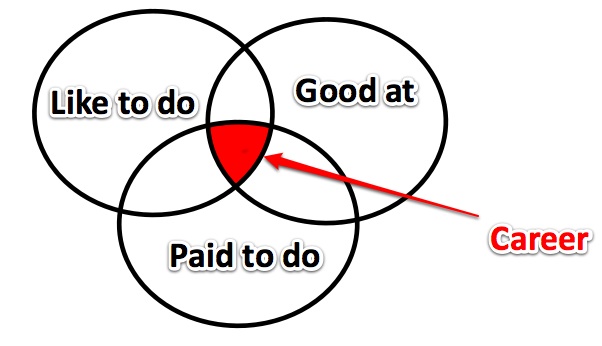
When Should I Work. When I interned in college and my co-workers talked longingly about their plans for their 2 weeks off in the summer, I wondered if it would be possible to have a job that seemed like vacation for 50 weeks a year and then leave the other 2 weeks for family vacation. In other words, what if you liked your job so much and you were so good at it that your job was all you wanted to do all the time? So instead of working 9 to 5 because you had to, you worked all the time. This developed over time into another rule about jobs: Work at a job that you like to do, are good at doing, and people will pay you to do.

The Three Circles. I passed this advice on to my children when they were in college. I said to draw three intersecting circles. In one circle list what you like to do. In another list what you are good at. And in the third list what people will pay you to do. Where the circles intersect is your career. Here’s what it looks like:

And that’s all I know about jobs.

Holiday Cards and Greetings

There is still plenty of time for you to do this, so no excuses.  The approaching holidays and the end of 2011 provide you with an excellent opportunity to connect with your business associates, your old and new friends, and especially your family and extended family.

Think Professional.

For professional, I am a fan of paper cards and brief notes.  If carefully chosen for suitability and taste, this is one of those things that people really do remember for the right reasons (and will never forget if tasteless or strange).  My advice is to stick with New Year Greetings if you are not absolutely clear about what holidays your associates and friends recognize.   Write a nice note inside the card, addressed specifically to the intended recipient.

I am not opposed to letters about your family and everything you did last year.  Actually I kind of like learning about your past year, and truth be told, I think your accomplishments are the best part.  TMI is TMI though, try to stay away from discussions of body parts, money, politics, religion, arrests or scandals, and weight loss or gain.  If you did not or cannot phone your friend about any of these topics and would not be inclined to have an in-depth conversation with your entire list about the relative merits of one alternative or another on the subject, it probably is not suitable for a holiday update.

I am not a fan of the digital card.  First, I am reluctant to click on things, if they even make it through the spam filter.  Second, I don’t want to see you Elf Yourself  again, it’s been done.  To. Death.  When I am thinking about referring a client to you, or nominating you for something good, or considering you for a job I heard about, do you want the image that comes to my mind to be your cut out face on a dancing cartoon elf body?

So here are my thoughts:

1.  Go to a card, stationery, or department store and pick out something that you think looks like you, and recognizes the holiday you celebrate.

2.  Pick out a second set, for those who celebrate that which you don’t.  That is, those who you know celebrate the holiday acknowledged by the card.

3.  For the rest (or alternatively, for everyone), select a Peace or Happy New Year card.  Remember that the world isn’t either/or.  Some folks do not celebrate any religious holiday.  Some do not celebrate at all.

4. Choose nice stamps. Use the right amount of postage for the card size.

5.  Use a good pen and write or print in your best writing or printing. Do not use turquoise or other odd color ink, funny writing, or scent.

6.  Use this opportunity to organize your contacts and look up correct addresses.  Sort.

7.  Write short, nice, memorable notes, like “We miss you.”  Or, “Remember that time we all bought stocking caps and mittens and wore them all Christmas Day because the furnace broke?”

8.  For close friends and family, send a photo or two in the card, if you can, and if they are good photos in good taste.

9.  Do not solicit anything, including business, referrals, return mail, or even a phone call.  This is you saying “hello, it’s me; you are my friend,” nothing more.

10.  Make a list of those to whom you have sent the cards.  This is your holiday card list.  If you get cards from people who are not on your list, you may send a card back, if you choose, or add them to your list for next year.

Lists are good things to have; you should get into the habit of creating and culling them.  Every five years or so, start all over again, sort of like zero-based list making.  Think through the list and the individuals on it; size is not the important thing, but tenure on the list and your ability and willingness to spontaneously create the personal note matter most.