Category Archives: Finding a Job

All about organizing.

It Doesn’t Work That Way

You see a job posting.  You like the title, like the look of the job, love the location; you know you are perfect for this job.  You push the send button on the resume you use for all the perfect jobs you find, the ones you just know you can do better than anyone else.  All you have to do now is wait for the phone call, the interview, the offer. 

Okay, it really doesn’t work that way.  You have just made a mistake.  Well not a huge one, but I think the odds are not in your favor.  Here are some reasons why:

1.  The job might not exist at all.  Oh yes, it’s posted somewhere, and someone might have held that job once upon a time, but for now it might very well be a budget placeholder, approved and funded and as long as it’s empty, keeping a department somewhere in high enough cotton to protect the really valuable jobs and people in them.

2.  An agency, recruiter, or contractor is gathering resumes and hoping to score paying clients–either you or a company who will soon get your recently floated and slightly redacted (missing your name and contact info) paperwork.

3.  The posting is required by the company’s affirmative action plan or other internal policy, but the real candidates are already working for the company and have been preparing for that job for many years.

4.  The posting is required by the company’s affirmative action plan or other policy, but the real candidates are those who will see the posting and look for a friend or other inside connection.  The friend will hand carry a specially crafted version of the clever candidate’s  resume complete with personal recommendation to the hiring manager or top HR executive with a friendly smile, and hope that he or she will earn the usual bonus for referring the candidate who gets the job offer.

4.  The job has been posted four times this year and hundreds of candidates have been screened.  No one is hired because the job is really a political minefield between two department managers who want control of the turf, budget, output, and incumbent.  Lucky you, this one is the bullet you dodged.

5.  No one wants to tell the sucker to whom the job reports that this is really his or her job, once the reorganization takes place.  Meanwhile half the company is in on the strategy to “just leave it alone, we’ll tell him/her when the right time comes.” Or we’ll get HR to do it, so don’t let them in on the secret.

6.  The job was eliminated a month ago, but those lists are automated and the recruiter who is supposed to correct the list is on vacation/furlough/sick leave/drugs.

7.  The job listing will eventually expire and this will all be resolved.  Nobody ever gets hired from those job boards anyhow.

So, you say, this makes no sense.  Why would my perfectly good resume not make everyone over at that crazy company sit up, take notice, and call me right away, even if any of those things you said are at least slightly true?  Because that’s not how it works. 

Fewer than 4% of all the people who get jobs this year will get them by hitting that send button and applying for a job they saw online.  My deepest suspicion is that in that 4% are those who were directed to apply that way because the company has no other way to connect its applicants with its tracking system, and so they referred the insiders to the outside to get them officially inside, if that makes any sense.  Applicant tracking systems are supposed to do a lot of heavy administrative lifting, but they have rules and standards that must be obeyed.  Some require that you all use the same front door, hence the need to have your buddy lead you to and through it.

My very favorite authority on finding a job, Nick Corcodilis, has the definitive analysis of why you don’t want to pin your hopes–any hopes at all–on job boards:

Job-Board Journalism: Selling out the American job hunter (from 2003 – but still valid as the day is long…)

And that resume of yours.  When you load it up with all the cool and award winning stuff you ever did, making such a heavy handed case that you must be the Right One, and so that it will work for all the jobs you might ever want. . . well, you look a.) old, b.) desperately competitive, c.) not fun to work with, and d.) a little naive. 

Attaching samples of your work.  No, a thousand times no. Once your work is done, it’s over.  Even though I might love to revisit the very first compensation plan I ever wrote from beginning to end, some of the people it covered are gone now, for good.    Yes,  the plan is over for them, as it was over for me when the plan year and my employment with that company ended. 

On the other hand, when your stripped down sports model of a resume is hand carried by either the retained search firm who got your name from a good buddy of yours that you had lunch with last week, or your good buddy himself or herself, it doesn’t matter what’s on the resume. 

What gets you the job you want is a relationship with someone who can get you invited into a great conversation with the decisionmaker, who ends up liking you, trusting you and wanting to work with you.  Period.  That’s just how it works.

Get Your Assets in Order

The Job Whisperer’s top eleven personal assets and must-have resources for almost anyone (but especially young professionals) seeking a 2009 career brand, because passion and determination are no longer enough.

Resume.  Your resume should proclaim “I love work!” and “Bosses love me and give me lots of responsibility!”  Don’t just enjoy talking about work and responsibility, be unable to waste time.  Work when you aren’t working, talk about what you love about your work.  Be your best advocate.  That’s a brand with energy and a brand you want to be.

Research.  What are the available jobs in your community?  Are they clustered in one or another sector, profession, or discipline?  Once you have established where the jobs are, you can build your campaign in the direction of the jobs, sector, profession, or discipline.  This process increases your understanding of the depth and breadth and capacity of your market, making you a better marketer of your brand and its value.

Reputation.  Be the calm level-headed one.  There’s one in every group, at least one, who gets things done and maintains order and forward mobility.  Be that one.  There are other desirable and fun things you can be, of course, but if you want a solid brand image for the ages, this is it. 

Nice, Stable Friends.  If you are a shy person, make new friends anyway.  If you start friendships but have trouble maintaining them, this would be a good time to learn how to manage your time so that you can spend it with others.  Start a walking group, go to your neighborhood association meetings, find a church and reach out.  People with friends have networking opportunities; people with nice, stable friends have good prospects.  People without friends and people with unstable friends have a harder time finding a job or moving a career forward.

Sturdy bridges across relationships.  Don’t burn bridges, and mend any you may have damaged.  Learn the art of restraint, by simply restraining your impulses.  The first question in the mind of a decision-maker or network contact is:  “Is there a downside risk here?”  Make sure that when your name comes up, the first association is anything other than the word “trouble.”

Advisers who want you to succeed.  If you have not been good to others or yourself, that’s a brand you don’t want.  Stop that right now, and make the fact of stopping unproductive behavior your central story as you seek people who are willing to forgive you and help you.  Like the prisoner who found salvation, the addict who found recovery, or the bully who became the defender of the meek, your story and brand will have to be about change.   The point of a brand is to be memorable in a good way. 

Personal Philanthropy.  Volunteer at one thing, not at a million things, but make it a significant volunteer gig that reflects something you really care about.  Try to achieve a leadership level in a small but important organization, make a professional contribution (do the accounting, the brochures, or raise funds), or found a new organization.  Volunteering at the nuts and bolts level (which lies above the pair of hands level) puts you in touch with members of the organization or the organization’s board, in addition to the organization’s constituents.

Publication.  It can be a blog, a Facebook page, a website, a series of articles, or even a book, but publish your thoughts and ideas.  Publishing what you know and what you care about will set you apart in a world of talent.  Publishing doesn’t make you an expert, but it makes you someone with a point of view, someone with confidence, and someone worth talking to.  Use your spell checker and if you need one, enlist an editor from among your advisers. 

Good Stories.  Good stories about your life experiences have a defining quality, and a beginning, a middle, an end, and an outcome.  And a central figure: you.  They are sometimes the kind of stories you might recount on a grad school application, or you might tell in a speech, or to a new but important person in your life.  Our stories are unique, and that’s why we tell them—they present energy, evoke empathy, and create bonds.  Reflect on the important moments and experiences of your life, and build your stories around them.  Be honest, but not exhaustive.  Good stories are brief but powerful.

Sales Training and Experience.  Get yourself a sales job, just for a while, even if—no, especially if—you have no idea how to make a cold call.  Everybody should work in sales sometime during a career.  Working in sales teaches you what drives the top line.  You will learn to sell yourself, deal with complete strangers confidently, and express your value, even if you never want to sell anything again.

Entrepreneurial mindset.  When I was a pre-teen, my grandmother gave me one of those potholder-making kits.  Before long I’d made thirty or so colorful potholders, I’d organized my younger siblings into a door-to-door army, and I was asking my parents for more equipment and raw material.  This is when my father explained to me the concept of profitability and the role played by expenses.  A business owner understands problems from a different angle; be self-employed somewhere along the line.

It’s hard not to notice that Great Big Honking Network is missing from The Job Whisperer’s list.  Well, it’s in there, in a way, and in another way we think that it’s not so much a noun as it is a verb.  It’s something you do in order to meet nice, stable friends, build sturdy bridges, and locate advisors who want you to succeed.  Sometimes the shorthand in articles and books about jobs and careers is confusing, and sometimes we mistake profiles in cyberspace for members of a network we own.  Here’s the difference.

You can have a network, you can build a network, you can promote a network, you can be a member of a formal networking group, but it’s not really an asset or a resource unless or until it includes nice, stable friends, sturdy bridges across relationships and advisors who want you to succeed.  The network is a conceptual framework representing what you make of those assets and resources, at a specific time when you need a very specific kind of help.  It isn’t real.  You don’t wake up one morning and decide to procure one of those network thingies. 

Imagine having a party and inviting all your friends and acquaintances.  When you stand up to toast the guests, are you going to say, “Here’s to my wonderful network!” or “Here’s to my wonderful friends!”  I hope you see the difference. 

I think it’s okay to map your conceptual network to try to find a path to your goal.  I think you must build a data base of your friends and advisors, and identify the sturdiest bridges, and connections you need to work on.  But these are activities best done in the spirit of organization, not exploitation, and there is an important difference.

Why Does it Take So Long to Get a Job?

You were laid off in December, took the holidays off because you think no one is hiring in December anyhow, and started working on your resume in January.  You finished a first draft, passed it around to your friends in the biz, got some feedback, made some changes, and now you think it’s ready to go. You’ve got some networking meetings set up, and you’re checking the job boards for whatever might turn up in your area.  You’re willing to step outside your profession if the right opportunity comes up, and you see yourself as flexible.  So now it’s what, mid-February?  How long is this going to take, exactly?

 Here’s how you see you getting a job:

job4me1

Here’s how the company sees the process:

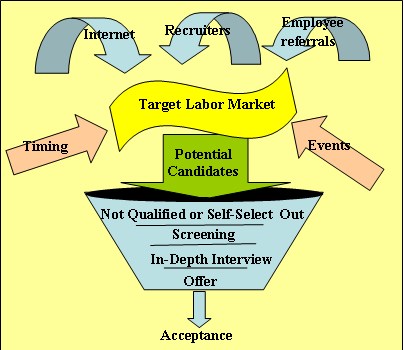
funnel1

Big difference.  And the bigger the company, the bigger the difference.  For you, this is fairly linear.  For the company, this is a big fat budget item with lots of twists, turns, and performance measures and objectives, and with staff and money (and maybe company politics) involved.  No rush on this, by the way, because conducting the business of the organization takes priority over filling open jobs, and fastest isn’t always the best when it comes to hiring. 

 Note the arching blue arrows in the second diagram—those are the investments that companies make in order to find people who fit.  Although the arrows are all the same size, the investments and their value are not the same.  More weight is given to the best sources—the ones that pay off consistently with a terrific ROI, however the company defines that.  Most experts believe that the best ROI comes from employee referrals, and the lowest selection rate is from the internet, but there are exceptions. 

The pink arrows show the influences that affect the size of the labor market.  Some events cause a labor market to grow; sometimes a market shrinks in response to events.  One example of timing is the college graduation season (causing the labor market to grow in some places and shrink in others), another is tourism in seasonal markets (causing the labor market to shrink).  When labor (also called talent) is plentiful, company investment in outreach slows; when the talent pool shrinks, the outreach spend goes up.   A labor market may be huge but the number of potential candidates suitable for a job may be very small.

 See the green arrow pointing down?  That’s you and your competition—some are just names the company has been keeping an eye on, some are friends of employees, and some are just like you, a five or six week old resume with an unemployed citizen attached to it.  Most won’t get to the next step. 

If they/you do, the blue bucket contains all the hoops left to jump through, and there are probably several hoops at each level.  The higher up in the company the job is, the greater the number of interviews.  However, if you are in the line for a training program, internship, or other visible slot, the more complicated are the hoops.  You might add Assessment Center Testing, Group Interview, or Day of Informational Interviews and Reckoning to that list of hoops.  It can take months—lots of months—to get through the entire process.  And then the job might be eliminated before it’s filled.

 Keep in mind that while all of this is going on, the salary and benefits money for the approved open position is not being spent.  Though work might be piling up, the department line item is favorable to budget, and the chances of the position being cancelled without being filled grow with each passing week.

 Remember that some companies post jobs for their employees across the country to bid on and may assess all or some of their internal candidates before considering external applicants. 

Some companies interview a slate of applicants and focus attention on the job all at once.  Some companies interview when they see someone they like.  HR handles logistics and scheduling, but they don’t control it.  There are references to check and details to verify. The decision-maker decides when it’s time to hire, and no one gets hired until that happens.  Newsflash: you have no control over any of this. 

 When someone tells me they got a call about a great job, or a headhunter called them, or they sent a resume in response to a job posting or ad, I suggest they not get ahead of the company’s plans.  You are not in a committed relationship with the company, its recruiter, a job, or the prospect of a job.  You are just you, same as you were yesterday. 

 So how long does it take to get a job?  A long time, once you find you are actually in the running for one.  Longer, if you find you are not. 

Sometimes it all works out, but it takes time.  When the process begins to drag out, it’s not a good sign for you, although I once got a job offer after another candidate turned it down.  It was a great job; it just took a while to get it.  I had already moved on, and so was clear-headed and thus able to see that my negotiating position had improved.  I believe that I got a better offer by staying calm and by being a smidge less anxious to jump aboard when they called me back.

Companies do tend to move quickly when they see the candidate they think they want, and if that is you, it might leave you breathless.  Breathe.  Keep a level head; a fast moving train is a dangerous vehicle.   The speed could be due to a last minute attempt to get someone hired before a budget deadline.  If the attempt fails, you’ll be dropped on your head.  If it succeeds, you could be dropped on your head after you are hired.  It really does happen.

The speed could be due to a recruiter trying to get a payday.  This has actually happened to me as a candidate.  The recruiter was out way ahead of the company, on a completely different page, trying to use several (not just me) willing candidates to elbow some other guy’s nominations out of the way.  It was very exciting to drop everything, fly to Seattle, fly back, debrief, fly somewhere else to meet someone else, until it became more ridiculous than exciting.  Of course, they ended up (drum roll) filling the job with someone from another division of the same company.  Keep your cool.

 So that’s why it takes a long time to get a job—because companies take their time and a lot of yours.  This is why you need to be active and engaged in what you want and how you are going to get it, all the time.  There is nothing you can do to speed up an organization’s process, but you can control your own time, your own process, and your own decisions.  It can be exciting to be recruited and romanced, but remember, you are dealing with professionals managing a process and their job is to make you feel wanted and needed and very special at all times.  It feels great, but means next to nothing until the offer is in your hand.